|
|
||
|
|
Procedures
Wisdom teeth (your third molars) are the last teeth to come in—and the ones least needed for good oral health. They may not erupt, or emerge from your gums, until your late teens or early twenties—if they erupt at all. Most often, they’re impacted, or trapped in the jawbone and gums, usually because there’s not enough room for them in your mouth. Our jaws are smaller than those of early humans, who needed large jaws and more teeth for their tougher diet. We don’t need that extra chewing power anymore. In fact, wisdom teeth often do more harm than good, and your dentist may recommend having them removed. Painlessly, of course.
From Silent to Serious Problems
If they are impacted, you may not even know you have wisdom teeth—until pain suddenly strikes. The pain may be caused by an infection or pressure on the gum or an adjacent tooth. Late, partially erupting wisdom teeth may cause crowding or shifting of your teeth or bite. You may not know that your developing wisdom teeth are pushing on the roots of adjacent teeth—until those teeth start to shift and supporting bone is destroyed. If your wisdom teeth do erupt, they may be hard to clean, so the odds of decay or infection of surrounding gum tissue are high.
Removal May Be Wise
Whether you have obvious symptoms or not, you can rely on Dr. Caplash's expertise to diagnose existing or potential problems caused by your wisdom teeth. If your dentist recommends their removal, it may be the wisest choice for the health of the rest of your mouth.You can help make your treatment a success by understanding why your wisdom teeth may need to be removed, what the procedure involves, and what you can do to promote a successful recovery.
UNDERSTANDING YOUR WISDOM TEETH
Most people have four wisdom teeth, one in each corner of the mouth, but each tooth can be at a different stage of eruption and position of impaction. Since wisdom teeth develop over a period of many years, harmful changes in your mouth may be gradual. But these changes could result in sudden and severe pain and infection. If you learn the different ways wisdom teeth can develop, you’ll be better able to understand why you may need to have them removed.
How Your Wisdom Teeth Grow
By your late teens, your jawbone has nearly reached its adult size. But sometimes it isn’t big enough to hold developing wisdom teeth. When this happens, your teeth become trapped in the bone and grow wherever they can. The crown (chewing surface of the tooth) may only partially break through the gum. In other cases, it may remain completely in the bone.
Positions of Impaction Cramped for room, impacted wisdom teeth grow in many different directions, commonly at an angle. A wisdom tooth may grow at an angle toward your other teeth (mesioangular position) or away from your other teeth (distoangular position). They also can grow into a horizontal or vertical position.
The Advantages of Early Removal Like all teeth, wisdom teeth develop inside an opening (socket) in your jaw, protected by bone and gum tissue until they erupt. Over time, your wisdom teeth become more firmly anchored in your jaw as their roots lengthen and the jawbone becomes more dense.
Wisdom Teeth Problems Whether wisdom teeth cause your mouth harm depends on several factors, including the size of your jaw and how your wisdom teeth grow in. Most often, impacted third molars cause problems in the late teens to early twenties, the years of young adulthood. Thus, the term 'wisdom teeth". Problem wisdom teeth cause symptoms like pain and swelling. Or you may have no symptoms at all, but the other teeth in your mouth could be at risk for damage. Gum disease. When a wisdom tooth partially breaks through the gum’s surface, bacteria and food can get trapped under the gum flap. This can infect the gum, supporting bone, and nearby teeth. Crowding. An impacted or erupting wisdom tooth can push on adjacent teeth, causing them to become crooked or even damaging them structurally. Decay. A wisdom tooth that is hard to clean due to its position or because it is partially covered by gum tissue will accumulate decay-causing bacteria. This could also lead to decay in the tooth next to it. Poor position. A wisdom tooth that grows toward the cheek can irritate nearby tissue. If an erupted tooth is crooked, it may be hard to clean and can even make it hard to bite down. Cysts. If the sac that holds the crown remains in the bone, it can fill with fluid, forming a cyst that can destroy surrounding bone.
YOUR DENTAL EVALUATION Are your wisdom teeth threatening the health of your mouth? An evaluation by Dr. Caplash can answer this question. He will take your dental and medical history, examine your teeth, and take x-rays to assess the health of your teeth. If your evaluation pinpoints a problem with your wisdom teeth, Dr. Caplash may recommend surgery to remove your wisdom teeth and eliminate your symptoms. To protect your mouth from future problems, Dr. Caplash may recommend early removal of your wisdom teeth. In most cases, the healing process is easier if all the wisdom teeth requiring removal are taken out at the same visit. Taking Dental X-rays Panoramic x-rays provide a clear image of the area around all four wisdom teeth, as well as surrounding bone. These x-rays can show hard-to-image impacted teeth more completely.
YOUR SURGERY EXPERIENCE
Your third molar surgery will be performed painlessly and safely in Dr. Caplash's office. To help the surgery go smoothly, follow the instructions on how to prepare for surgery.
Preparing for Surgery You may need to take some days off work or school to give yourself enough time to recuperate.
Eating If you are going to "go to sleep", don't eat or drink anything after midnight the night before surgery.
Transportation Arrange to have a responsible adult take you home and to be with you for the first 24 hours or so postoperatively.
Clothing Wear loose, comfortable clothes. Choose a shirt or blouse with loose short sleeves, so if you receive an IV anesthetic, it can be administered easily. Please do not wear flip flops or sandals.
After Surgery
When Dr. Caplash is satisfied with your progress, you will be able to go home. You will be given instructions on how to take care of yourself. Medications to control pain, minimize swelling and prevent infection will be prescribed. Plan to rest at home for the remainder of the day. If you had IV anesthesia, have someone stay with you overnight. During the next few days, don’t plan on exercising, driving, drinking alcohol, or operating any kind of machinery; you may be drowsy from the medication. Detailed instructions will be given verbally and in writing.
Life’s simple pleasures can cause problems and pain for the millions of adults who suffer from permanent tooth loss. Men and women of all ages are self-conscious about their dentures, bridges or missing teeth. Some have difficulty speaking because their dentures slip or click.
For others, the irritation and pain caused by dentures are constant reminders of the limitations they feel. Many are concerned about their appearance and may feel that their tooth loss has “aged them” before their time.
Some regularly decline invitations to social events because they are unwilling to face the uncertainties of eating, speaking and laughing in public. Many can no longer enjoy their favorite foods, nor the social interaction with family and friends that accompanies special meals.
A Unique Solution to a Troublesome Problem
Now, more and more people are putting an end to these problems by choosing dental implants, a revolutionary way to replace missing teeth. Dental implants offer an excellent alternative to the limitations of conventional dentures, bridges and missing teeth.
What Exactly Is A Dental Implant?
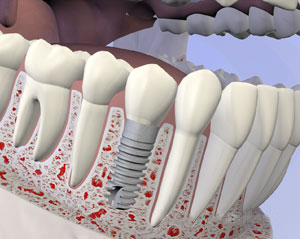
Simply stated, a dental implant may be considered to be an artificial tooth root, painlessly placed into the jawbone. The patient's dentist constructs an artificial tooth (restoration) which is secured to the implant. Implant-supported restorations look, feel and function just like beautiful, healthy natural teeth. Dental implants are changing for the better the way people live. With implants, people are rediscovering the comfort and confidence to eat, speak, laugh and enjoy life.
Why Are People Choosing Dental Implants?
A national survey of oral and maxillofacial surgeons found that patient interest in and demand for implants has grown significantly.
The survey found:
Leading reasons cited for choosing dental implants are:
According to the survey, the reasons for the increased demand are:
An Alternative to Natural Teeth
Dental implants are a great option for patients missing natural teeth, because they act as a secure anchor for artificial replacement teeth and eliminate the instability associated with surface adhesives and removable bridges.
Your natural teeth absorb biting pressure of up to 540 lbs. per square inch. Long-time denture-wearers can often absorb no more than 50 lbs. per square inch. Dental implants, when properly placed, can withstand 450 lbs. per square inch of biting pressure.
Dental implants are made of materials that are compatible with human bone and tissue. Small posts are then attached to the implants which protrude through the gums. These posts provide stable anchors for artificial replacement teeth.
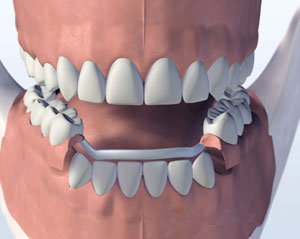
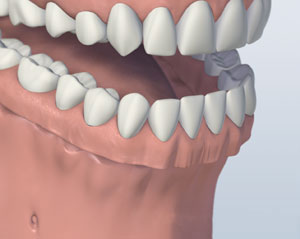
Dental Implants Fit Patient Needs. Based on patient needs, a single tooth, a partial bridge or a full set of replacement teeth are fitted to the implants and locked in place over the protruding posts. In appearance and in function, implants are the closest thing to natural teeth and a good alternative to conventional dentures.
Implants eliminate the day-to-day frustrations and pain of ill-fitting dentures. They allow people to enjoy a healthy and varied diet without the restrictions many denture wearers face. With a sense of renewed self-confidence, many people rediscover the excitement of an active lifestyle shared with family and friends and the chance to speak clearly and comfortably with co-workers.
For all these reasons, people with dental implants often say they feel better . . . they look better. . . they live better.
What to Expect
Dr. Caplash can determine if you are a candidate for dental implants. You will be evaluated based upon a number of things including dental health, lifestyle, jawbone quality and oral hygiene habits. In close consultation with your own dentist, Dr. Caplash can plan your dental implant treatment program.
A Two-Phase Procedure. For most patients, the placement of dental implants involves two surgical procedures. First, the implants are painlessly placed into your jawbone. For the first three to six months following surgery, the implants are beneath the surface of the gums, gradually bonding with the jawbone. During this time, you should be able to wear temporary dentures and eat a soft diet.
Some patients do report minor pain and swelling immediately after the procedure but most experience no change in their daily routines.
While the implants are bonding with the jawbone, new replacement teeth are fashioned by your dentist. So, it is important that they are created by a dentist with proper training in restorative techniques.
Once the implants have bonded to the jawbone, Dr. Caplash painlessly uncovers the implants and attaches small posts which will act as anchors for the artificial teeth. The posts protrude through the gum line but are not visible when artificial teeth are attached. This second procedure is a very minor one.
The entire process, from evaluation to completion, generally takes six to twelve months. During this time, most patients do not experience any disruption in their normal business and social activities.
Because dental implants are made of materials that are compatible with human bone, there is little chance for an allergic reaction in the body. However, implants can fail when proper oral hygiene techniques are not used. Dental implants require special individual care. Proper brushing, flossing, rinsing and regular check-ups are critical to the long-term success of your implants.
A Team Effort
Dental implants generally warrant the expertise of two dental professionals - an oral and maxillofacial surgeon (Dr. Caplash) and your restorative dentist. Working as a team, Dr. Caplash and the restorative dentist can determine if you are a candidate for implants and design an appropriate treatment plan.
Start a New Way of Living Today
If you are among the millions of Americans who suffer from permanent tooth loss, you can eliminate the problems and pain caused by dentures, bridges or missing teeth. You can begin to rediscover the joy of eating healthy, speaking clearly and laughing comfortably. Take the first step. Get the facts about dental implants. See your dentist or Dr. Caplash. With their training and expertise, they can determine if dental implants are right for you.
Source: American Association of Oral and Maxillofacial Surgeons
Platelet rich plasma greatly accelerates wound healing and induces formation
of new bone where desired.
PRP has many clinical applications including:
This is the part of oral and maxillofacial surgery that restores oral function and facial form rendered deficient through loss or absence of teeth and associated structures as a result of disease, trauma or elective surgery for tumors and other conditions. This may be achieved by combination of surgical and prosthetic technique.
Source: The British Association of Oral and Maxillofacial Surgeons
Dr. Caplash will give you a comfortable, safe sleep for your procedure. After you are asleep, he will administer "numbing" injections into the surgical sites. When the surgical procedure is completed, you will awaken feeling comfortable and free of pain. Since the "sleeping medication", in a pleasant way, distorts your sense of time, it will seem to you that you've been asleep only a few minutes. You will not have pain to tell you the procedure has been completed. Ergo, often the patient doesn't even realize he has been asleep and had the work done!
After surgery, Dr. Caplash will employ
sophisticated pharmacology and prescribe a number of medications to keep you
comfortable.
For more information please
contact our office to schedule a consultation.
Home / About Our Practice / Meet Dr. Caplash / Meet Our Staff / Procedures / Typical Postoperative Instructions / Questions / CareCredit Patient Payment Plans / Office Policies / Office Hours / Map & Directions / Contact Us
Copyright 2004 Dr. Jolly Caplash. All rights reserved. Web Design by M.Panessa Hosting by Precisehosting.net
|
|